Search for a free art portfolio website and you'll find dozens of builders that say "free." Most of them mean one of four things: free with their ads and branding, free for 14 days, a free profile on someone else's platform, or free with a subscription you already pay for.
We checked the main builders on their own pricing, help-center, and terms pages on October 6, 2026, and asked three questions: what does "free" actually include, what does a site with your own domain cost each year, and what happens to your portfolio when you stop paying?
Then there's a question the "best portfolio sites" lists never ask: is a scrolling grid of thumbnails the best way for someone to experience your work? We'll come back to that, because it's the reason Xibit360 exists.
Full disclosure: Xibit360 is our product. Portfolio builders do several things better than we do, and we say so below.
Here's what a walkable portfolio looks like, hung with Alphonse Mucha's work:
The short version
| Builder | Free plan? | Cheapest plan with your own domain | If you stop paying |
|---|---|---|---|
| Wix | Yes — Wix address, with Wix ads | Light: $17/mo, billed yearly | Back to the free Wix address, with Wix ads |
| Squarespace | No — 14-day trial | Basic: about $19/mo yearly or $25/mo monthly* | Site goes offline ("Website expired") |
| Format | No — 14-day trial | Basic: $10/mo yearly or $14/mo monthly | Archived for 12 months after the paid period |
| Pixpa | No — 15-day trial | Basic: $5.40/mo billed yearly (25% off the first year on top) or $9/mo | Website "will become inactive" |
| Portfoliobox | Yes — small plan on a Portfoliobox address | Personal: $8.50/mo yearly or $11.70/mo (+ VAT) | Not stated |
| Cargo | Build free, but publishing needs a subscription | $14/mo yearly or $19/mo monthly | Not stated |
| Adobe Portfolio | No — comes with Creative Cloud or Behance Pro | Behance Pro: from $9.99/mo, annual commitment | Offline 14 days after cancelling |
| Carbonmade | Build free; you pay to go live | Beginner: $9.99/mo | Closing the account deletes it; $12/yr "Hibernation" keeps it archived |
| Behance / ArtStation | Free profile (ArtStation also has a free basic site) | ArtStation: a paid membership (Pro from $9.95/mo) | — |
| Xibit360 | Yes — 1 room, 5 works, no time limit | No custom domain — embed your room in the site you already have | Nothing to stop paying; open until you close it |
Squarespace and Pixpa showed us local-currency or regional prices, so Squarespace's USD prices come from press coverage of its reported July 2026 price change (PetaPixel). Check each site for your region.
What "free" means on portfolio builders
- Free with branding. Wix, Portfoliobox, Canva (up to five sites on a
.canva.siteaddress with a "Designed with Canva" footer) and ArtStation's basic site let you publish for free on their address, with their name on your portfolio — and on Wix, their ads. - Free trial. Squarespace, Format, Pixpa and Artwork Archive give you 14–15 days. Pixpa's trial "pauses until you choose a plan." Cargo and Carbonmade let you build for free but charge when you publish.
- Free profile. Behance and ArtStation are communities: your work sits on their site, next to everyone else's.
- Bundled. Adobe says there is "no stand-alone Adobe Portfolio subscription"; it comes with Creative Cloud plans or Behance Pro.
None of these is a trick — hosting a full website costs money, and that's what you're paying for. But it means a "free portfolio" usually turns into a yearly bill the moment you want it to look professional.
The real cost of your own domain
A custom domain is the usual reason to upgrade, and it's really two bills: the site plan, and the domain itself.
- Wix: a paid plan is required. Yearly plans include a voucher for a free domain in year one; after that, Wix's own blog puts a
.comrenewal at $21.35 a year. Cancelling the site plan doesn't cancel the domain. - Squarespace: the free first-year domain comes only with yearly billing — it's "not valid for… monthly billing plans." After that,
.comand.orgdomains are $20 a year. - Format: a free first year only on Pro and Pro Plus yearly plans; otherwise $30 a year (or $75 for three years), non-refundable.
- Pixpa (Creator plan and up) and Portfoliobox (yearly plans, eligible extensions): free for the first year, then renewed at standard rates that neither page states in dollars. Pixpa's cheapest plan can connect a domain but doesn't include one.
So the yearly cost of a portfolio on your own domain is the plan plus roughly $20–$30 for the domain from year two.
Cost over three years
Here's what you pay to keep a portfolio online, on the cheapest plan with your own domain from two builders whose prices we could confirm on their own pages, next to a 20-work exhibition on Xibit360.
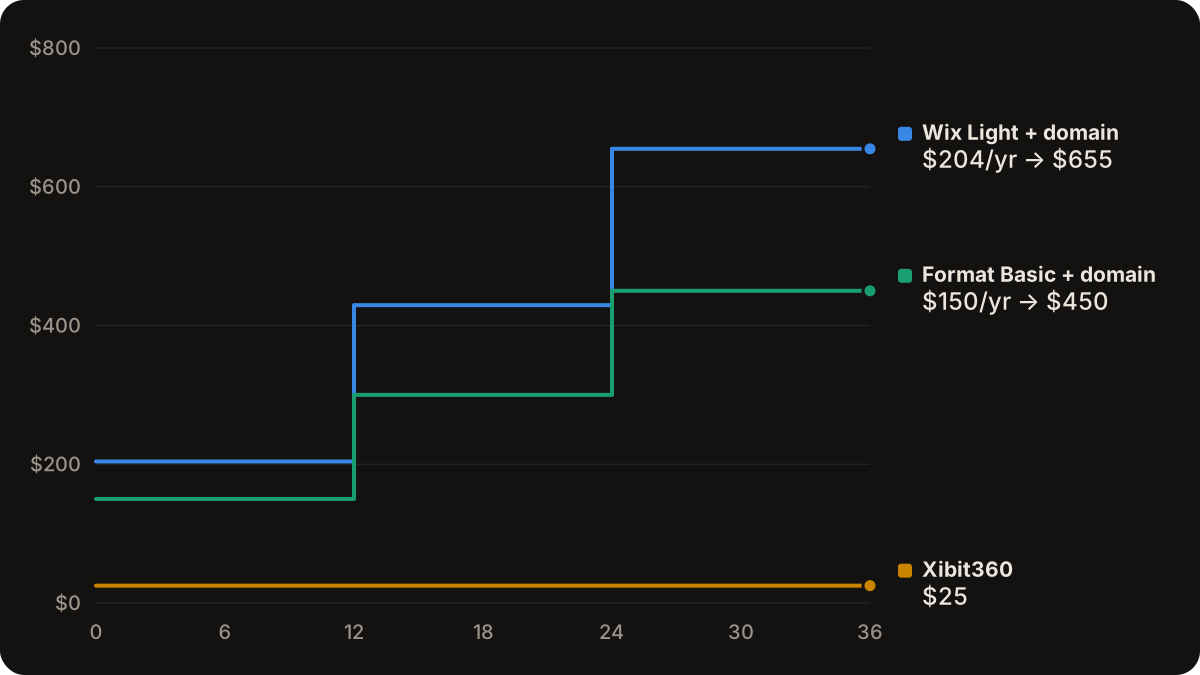
Total paid (USD) over the first 36 months. Horizontal axis: months. Wix Light at $204 a year with the first-year domain voucher, then $21.35 a year for a .com; Format Basic at $120 a year plus a $30 domain. Xibit360: a free room (5 works) plus one extra room (15 works). Taxes not included.
| Months online | Xibit360 (20 works) | Wix Light + domain | Format Basic + domain |
|---|---|---|---|
| 1 | $25 | $204 | $150 |
| 12 | $25 | $204 | $150 |
| 13 | $25 | $429 | $300 |
| 24 | $25 | $429 | $300 |
| 36 | $25 | $655 | $450 |
To be fair, this isn't an apples-to-apples comparison. A site plan buys you a whole website — as many pages as you like, a blog, a contact form, often a shop. A Xibit360 room is an exhibition. The point is the shape of the cost: a portfolio site is rent you pay every year; a room is bought once.
And if you already pay for a site, you don't have to choose — see "Use both" below.
Why a walkable exhibition instead of (or next to) a grid
A portfolio site is very good at one thing: showing many images quickly. But it shows them all the same way — the same-sized thumbnail, in the same grid, on a white page. A 30 cm drawing and a two-metre canvas look identical. Nobody walks up to anything.
How art is presented changes how it's seen. In a study published in PLoS ONE (Brieber et al., 2014), students who saw artworks in a museum liked them more, found them more interesting, and looked at them longer than students who saw reproductions of the same works on a screen — though the authors couldn't tell whether the setting or seeing the originals made the difference. Another study of 225 museum visitors in front of six Gerhard Richter paintings (Carbon, i-Perception, 2017) found that the size of a canvas closely predicted how far away people stood to look at it.
Neither study tested virtual rooms, and a 3D room in a browser is still a screen, not a museum. What it can restore is some of what a grid removes:
- Scale. Enter a work's size in centimetres and it hangs at its true proportions — and, for works between roughly 40 cm and 2.4 m tall, at its true size relative to everything else on the wall. A small drawing reads as small next to a big painting.
- A wall, a frame, light. Each work hangs under gallery lighting, with the frame and mat you choose and a soft shadow on the wall. It looks like a work on a wall — which is exactly what a collector is trying to picture.
- Pace. Visitors walk up to a piece, stop, and look. Nothing scrolls past them. A guided tour takes them from work to work in the order you hung them, so a series reads as a series.
- Sound. Your caption can be read aloud as an audio guide, or you can upload your own narration, and the room can play background music.
- Video in the room. With the one-time Video Pass, video works play on the wall as visitors walk past, instead of sitting behind a YouTube link.
- An invitation, not an attachment. Sending a gallerist, an open call, or a school a link they can walk through feels like being invited to a show. It's memorable in a way the 40th PDF in someone's inbox isn't.
How much this matters depends on who's looking. But art is already bought from screens: in the Art Basel and UBS Survey of Global Collecting 2025, 54% of the wealthy collectors surveyed who bought from a dealer had bought through a website or online viewing room without seeing the work in person (down from 74% in the previous survey). When your audience is deciding from a screen, how the screen presents your work is the whole first impression.
Where portfolio sites are better
- Your own domain and your own name in search. A site on
yourname.comis the strongest home for your name. Xibit360 rooms live atxibit360.art/@yourname. - Many pages. A blog, a press page, a long CV, workshops, a contact form.
- Selling. Several builders include a shop with checkout. On Xibit360, each work links to your own shop or print store — no checkout of ours, and no commission.
- Volume. A portfolio site can hold hundreds of images. A Xibit360 room holds up to 15 works, so a big archive means several rooms.
Use both: put the room inside your site
You don't have to choose between a domain and an exhibition. Every Xibit360 room can be embedded in the site you already have — paste the link (Notion, Canva, WordPress posts) or a short embed code, and visitors walk through the room without leaving your page. You keep your domain, your plan, and your search ranking, and add a 3D show to it for $0 (5 works) or a one-time $25 (20 works) — not a second subscription.
What builders allow, from their own help pages:
- Wix: an HTML iframe element; Wix's help article for it lists no plan requirement.
- Squarespace: iframes in code blocks work on Core and higher (and during the trial), but not on Basic.
- Format: the custom code editor is on Pro and higher.
- Pixpa, Cargo, Carbonmade: support embed or iframe codes.
- Adobe Portfolio: accepts iframe embeds from the providers it supports — if ours isn't accepted, link to your room.
- Portfoliobox: "No JavaScript or HTML injection" — link to your room instead.
And if you don't have a site yet, your Xibit360 page works as a simple free portfolio on its own: your bio, social links, and rooms on one page — and inside each room, a CV tab for exhibitions and awards.
What you get with Xibit360
- A free room you can publish today: 5 works, every frame style, no card, no time limit.
- Pay once to grow: an extra exhibition room (15 works) $25, artwork slots $3 each, a Video Pass for video works $20, themes $8, layouts $5, extra storage $10 per GB (100 MB included free). Nothing renews.
- Works at their true proportions, under gallery lighting, displayed at up to 1,600 px.
- An audio guide and background music, and video that plays on the wall (with the Video Pass).
- Share it anywhere: one link, embedding in your site, a walkthrough video for social media, and a catalog.
- Opens in a phone's browser with nothing to install (devices that can't run 3D get a simple list of the works).
- We never use your work to train AI, and never sell or license it for that.
Comparing 3D gallery platforms instead? See the best virtual gallery platforms for artists and virtual galleries without a subscription.
FAQ
What is the best free art portfolio website? It depends on what "free" has to cover. Wix and Portfoliobox let you publish for free on their address with their branding (and, on Wix, ads); Behance and ArtStation give you a free profile in their community. If you want your work shown as an exhibition rather than a grid, Xibit360 publishes a room of 5 works free, with no time limit and no ads.
Is there an art portfolio website without a subscription? Most portfolio builders are subscriptions, plus a yearly domain fee. Xibit360 has no subscription: the first room is free, and larger shows are one-time purchases — $25 for 20 works.
Can I use my own domain with Xibit360? Not directly. Instead, you can embed your room in the site on your own domain — Wix, WordPress, Cargo, Pixpa, Notion and others accept the embed (on Squarespace, the Core plan or higher) — so visitors walk through it on your site.
Do I need a portfolio website if I have a virtual exhibition? Not necessarily. If you don't have a site, your Xibit360 page holds your bio, social links, and rooms, with your CV inside each room. If you need a blog, many pages, or a shop, keep a portfolio site and embed the room in it.
What happens to my portfolio if I stop paying? It varies: Wix returns to its free address with ads, Squarespace takes the site offline, Format archives it for 12 months, and Adobe Portfolio goes offline 14 days after cancelling. On Xibit360 there's nothing to stop paying — the room stays open until you close it, and if Xibit360 ever shut down, our terms promise at least 90 days' notice and a way to download your files.
Start free
Walk through the demo gallery, then create your free room — and paste the link into your portfolio, or let it be your portfolio.
Prices, plan details, and quotes were checked on October 6, 2026, on each builder's own pricing, help-center, and terms pages (Squarespace's USD prices from PetaPixel's report of its July 2026 price change, which Squarespace hasn't published as a memo). Plans change — check each builder's site for current terms. Research cited: Brieber, Nadal, Leder & Rosenberg, PLoS ONE 9(6), 2014; Carbon, i-Perception 8(1), 2017; Art Basel & UBS, Survey of Global Collecting 2025.